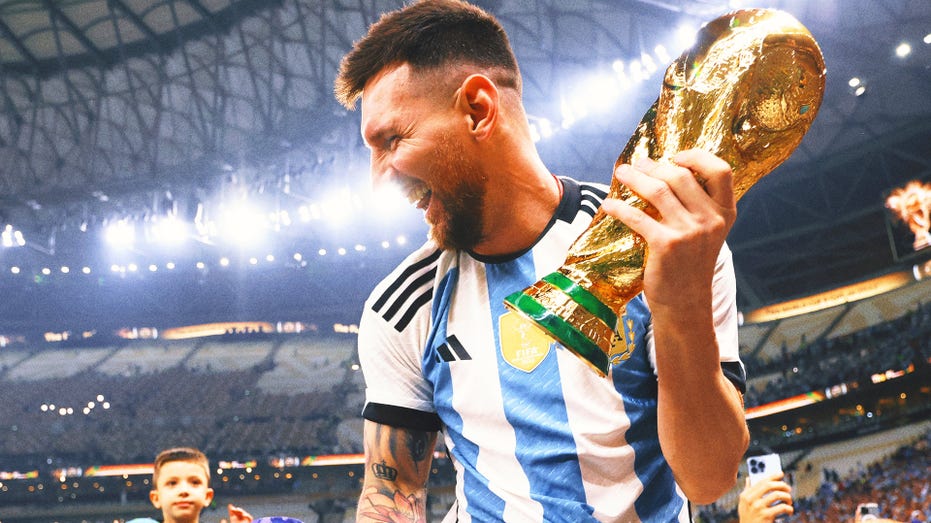
FIFA World Cup Trophy: 10 Facts About Soccer’s Most Prestigious Prize
Forty-eight teams from across the globe focused on winning the biggest prize in all sports this summer – the 2026 FIFA World Cup.
Global soccer stars like Argentina’s Lionel Messi and France’s Kylian Mbappé will be eyeing their second World Cup title of their careers. Others, like Portugal’s Cristiano Ronaldo and England’s Harry Kane are eyeing their first.
The prize in question, the World Cup trophy, is more fascinating than most fans think. And with only eight countries ever to win it – Brazil (five times), Germany (four), Italy (four), Argentina (three), France (two), Uruguay (two), Spain (once) and England (once) – its also one of the hardest ever to conquer.
Here are 10 facts about soccer’s most prestigious prize that you may not know.
Paired with two layers of green malachite on the base, the trophy’s total weight of 6.142 kilograms (about 13.6 pounds). While the inside of the trophy is hollow, it has incredible value based on gold content alone. The gold content equates to just over five kilograms (nearly 11 pounds) of pure gold – which would be around $550,000 as of April 2026. Of course, no one would dare sell one of sports’ most sought-after trophies.
The trophy that we see today isn’t the original. The first commissioned was the Jules Rimet trophy (named after FIFA’s first president), made of gold-plated sterling silver and consisted of a ten-sided cup, supported by a winged figure representing Nike, the ancient Greek goddess of victory. After Brazil won its third title in 1970, the team kept that trophy, leading FIFA to commission what is now the “FIFA World Cup Trophy” that we now see. The version we now see was first lifted in 1974 by hosts West Germany.
Throughout World War II, FIFA’s Vice President, Ottorino Barassi, secretly took out the trophy from one of Rome’s bank vaults. Why? To prevent it from falling into the wrong hands, or in their eyes, the hands of occupying forces. He then hid the trophy in a shoebox under his bed for the remainder of the war.
In March 1966, the Jules Rimet trophy was taken from an exhibition in London. Miraculously, a dog named Pickles sniffed out a package wrapped in newspaper while on a walk with his owner. The trophy happened to be sitting there and Pickles became a hero to fans across the world. England won its first and only men’s title months later – and Pickles was invited to the celebration banquet as a reward.
The Jules Rimet trophy was again stolen in 1983 while displayed at the Brazilian Football Confederation headquarters in Rio de Janeiro. Brazil then commissioned a replacement replica of the trophy, with only one section of the original ever officially recovered.
After the 1966 theft, England’s Football Association created a replica trophy that would be used for public exhibition while the real one was kept safe. In 1997, FIFA bought the replica at an auction for $400,000. That replica is now at England’s National Football Museum in Manchester.
The country that wins the whole tournament takes home an entirely different version of the World Cup trophy (known as the World Cup Winners’ Trophy). The main one is housed at the FIFA Museum, which is located in Zurich, Switzerland.
The pate at the base of the trophy gets removed after each winner, with it going to the FIFA Museum. A new one is added to the trophy with the name of the latest winner joining the previous champions in a spiral arrangement to accommodate future winners.
After their 2014 World Cup win, Germany partied in Berlin so hard that they managed to damage the trophy. Wolfgang Niersbach, the President of the German FA, admitted that a small piece of the trophy was chipped off. Luckily, it was the winner’s trophy, not the original that remains in Switzerland.
The main trophy does occasionally travel but is carefully handled by agents to ensure there is no damage when in transport. When it does hit the road, it is for events such as the World Cup Trophy Tour or the World Cup draw. It also makes an appearance at the final.
There is an unofficial custom that players follow in which one should never touch the trophy before the final. However, the real rules are actually much stricter: only World Cup winners and heads of state can touch the authentic gold trophy with their bare hands. Everyone else is required to wear gloves.
The World Cup will run from June 11 to July 19, 2026. Spread across three countries, the tournament will culminate with the final on July 19 at New York New Jersey Stadium in East Rutherford, New Jersey. All 104 tournament matches will air live across FOX (70) and FS1 (34) with every match streaming live and on-demand within both the FOX One and the FOX Sports apps. A record 40 matches, more than one-third of the tournament, will air in prime time across FOX (21) and FS1 (19).
Latest Sports News Today on Fox News